

Executive Summary:
The future of digital work is already here, driven by AI and profound global shifts. This analysis explores how the synergy between advanced technology and essential human skills (collaboration, creativity, empathy) is redefining digital teams. Discover the key macro-trends, the role of AI as a strategic ally, the critical importance of soft skills, and the strategies required to build resilient, adaptable teams ready to lead digital transformation.
The world of work is at a historic inflection point. We are witnessing an unprecedented convergence of transformative forces: the rapid acceleration of artificial intelligence (AI) and digitalisation, combined with deep economic shifts, environmental sustainability pressures, and new social and demographic dynamics.
This combination is radically redrawing the rules of the game — especially for those deeply rooted in innovation: digital teams. We face a landscape full of complex challenges, but also rich with extraordinary opportunities for those able to adapt and evolve.
The fundamental question is no longer whether work will change, but how we can actively navigate this transformation.
“The answer, increasingly evident, lies in cultivating an intelligent symbiosis between cutting-edge technology and the deliberate strengthening of our most intrinsically human capabilities: collaboration, creativity, empathy, and adaptability.”
A Closer Look at the Future of Digital Work: The Perfect Storm of Transformation
The World Economic Forum’s (WEF) “Future of Jobs Report 2025” leaves little room for doubt: we are in the midst of a deep and accelerated transformation of work. The report identifies several key macro-trends:
- Technology Adoption: Generative AI, big data, cloud computing, cybersecurity, EdTech. Technological fluency is now a baseline requirement.
- ESG Factors: Green transition, resilient supply chains, demand for ethical practices. New roles and cross-functional sustainability skills.
- Economic Context: Inflation, slow growth, rising cost of living. A push for efficiency (automation) and new business models.
- Social Expectations: Growing demand for flexibility, purpose, and wellbeing from workers.
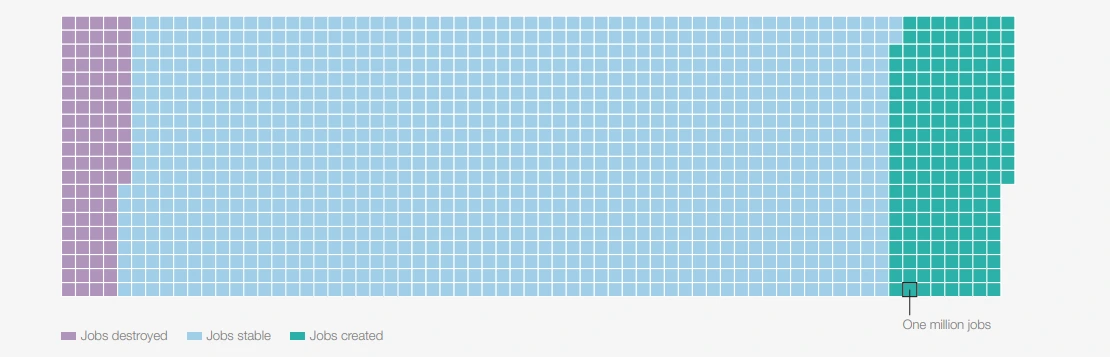
Source: World Economic Forum, Future of Jobs Survey 2024; International Labour Organization, ILOSTAT.
The net result is significant “turbulence”. The WEF estimates that nearly a quarter (22%) of current jobs will change substantially within five years. For digital and product teams, this translates into an urgent need for continuous adaptation. Roles such as data analysts, AI and machine learning specialists, cybersecurity experts, and developers will remain in high demand, but will require constant upskilling. Technological literacy and the ability to learn how to learn are critical meta-skills for navigating the future of digital work.
Generative AI as an Indispensable Strategic Ally
The exponential advance of artificial intelligence has triggered intense debate and anxiety. Fears of mass replacement are common. However, a deeper analysis points to a more optimistic perspective: AI is not here to replace us, but to augment our capabilities. It should be viewed as a strategic ally.
“AI is not here to replace us, but to enhance our capabilities.”
The real “magic”, as discussed in the conversation with Sol De Cabo on our “Digital Experience” podcast, still lies in human interaction: collaboration, debate, and empathy. AI can automate tasks (large-scale data analysis, draft generation, testing), freeing digital teams to focus on human judgement, strategic intuition, disruptive creativity, and deep understanding of user context.
The challenge is not to compete with AI, but to learn how to collaborate with it effectively. This requires rethinking workflows:
- How can AI be integrated into product discovery?
- How can it support the generation and evaluation of prototypes?
- How can it help personalise communication or optimise interfaces?
Strategic integration requires curiosity, experimentation, critical thinking to assess outputs, and ethical judgement to ensure responsible use.
Learn more about Generative AI here: Development Transformation: Generative AI as a Strategic Ally
The Essential Rise of Human Skills: Our True Differentiator in the Digital Age
Paradoxically, as technology advances, intrinsically human skills become exponentially more important. They are our true competitive differentiator. The WEF report confirms this, highlighting growing demand for:
- Critical and Analytical Thinking: Evaluating information objectively, identifying bias, and making evidence-based decisions. Essential for analysing metrics and feedback in product teams.
- Creativity and Innovation: Imagining radically new solutions. Encouraging experimentation and lateral thinking to create distinctive digital products.
- Resilience, Flexibility, and Agility: Adapting to change, learning from failure, and navigating uncertainty. Fundamental in digital product development.
- Collaboration and Social Influence: Communicating effectively across disciplines, building trust, and aligning stakeholders. Critical for co-creation in multidisciplinary teams.
- Empathy and Active Listening: Deeply understanding user needs. Key tools for uncovering insights and designing meaningful experiences.
- Curiosity and Continuous Learning: Staying relevant by exploring new technologies and methodologies. The engine of adaptation and reskilling.
- Self-Awareness and Self-Leadership: Understanding strengths and limitations to manage stress and communicate authentically. The foundation of personal growth and agile leadership.
“For digital and product teams, these are not ‘soft’ or secondary skills. They are the operational core that allows technology to be translated into real human value.”
Building Future-Ready Digital Teams
Transformation requires rethinking how we conceive, structure, and lead digital teams. It is about creating ecosystems where talent and collaboration can thrive.
1. Foster Adaptive, Human-Centred, and Enabling Leadership
The “command and control” model is obsolete. Future leaders cultivate psychological safety, transparent communication, active listening, and empathy. Their role is to ask questions, connect people, remove obstacles, and empower teams. This requires vulnerability and a service-oriented mindset.
2. Prioritise the Team over the Individual
Digital success is a team sport. Fostering a culture of genuine collaboration, knowledge sharing, and mutual support is essential. This involves designing cross-functional processes and celebrating collective achievements.
3. Cultivate a Growth Mindset
Believing that skills can be developed encourages resilience, learning from feedback, and adaptation. It is the antidote to stagnation in digital teams.
4. Drive Genuine Inclusion and Cognitive Diversity
Actively valuing diversity of thought, experience, and perspective. Creating an environment where all voices feel safe and heard leads to stronger decisions and greater creativity.
5. Embed Continuous Learning (Upskilling & Reskilling) into Cultural DNA
Learning must be continuous and embedded. Build a culture that values exploration, supports communities of practice, promotes mentoring, and celebrates curiosity. Upskilling and reskilling are strategic imperatives.
6. Position HR as a Transformational Strategic Partner
Human Resources (People & Culture) plays a pivotal role. It must partner in designing talent strategies, attracting the right profiles (potential and cultural fit), developing capabilities, supporting wellbeing, and enabling change management throughout digital transformation.
Conclusion: Weaving the Human–Technological Future of Digital Work
The narrative around the future of digital work is not a technology-versus-humanity dichotomy, but an intelligent integration. The path forward for digital teams is to embrace AI as a collaborator while strategically investing in what makes us human: critical thinking, collective creativity, empathetic connection, and resilient adaptability.
“The true revolution […] lies in consciously building work environments where people can thrive, learn continuously, collaborate genuinely, and feel that their contribution has purpose.”
Creating people-centred organisations and digital teams is a core business strategy for attracting talent, retaining it, and driving innovation. The future of digital work is, at its heart, profoundly human — empowered by technology.
Ready to prepare your digital teams for the future?
Discover how our tailored solutions in AI, outsourcing, and digital product development can drive your organisation forward.
[Contact our experts for a consultation] | [Discover our solutions]